Studio Soundproofing Panels: Treatment vs Isolation
Updated
Studio soundproofing panels are absorbers. They treat the room so your mixes and recordings sound accurate, but they don't stop sound from passing through the walls. Isolation (keeping the drums in and the traffic out) takes mass, decoupled framing and sealed gaps. Most home studios need treatment first, and isolation only if the neighbors or outside noise are a problem.
Treatment vs isolation: two different jobs
Treatment handles the sound you hear inside the studio, and it's rated by NRC. Isolation handles the sound that gets in or out, and it's rated by STC.
Treatment
NRC 1.00
A 2 in. fiberglass panel soaks up nearly all the mid-range sound that hits it. Fixes echo, harsh reflections and boomy bass in the room.
Isolation
STC 34 to 48
An insulated 2x4 wall before and after adding resilient channel to one side. Fixes noise leaking to and from the neighbors.
Those values come from the Owens Corning 703 data sheet (opens in a new tab) and USG lab tests (opens in a new tab). The soundproof panels guide covers both scales and every panel type.
Soundproof panels for a studio: where each one goes
Set up the room in this order: speakers and seat first, then the front wall, corners, side walls, ceiling and rear wall.
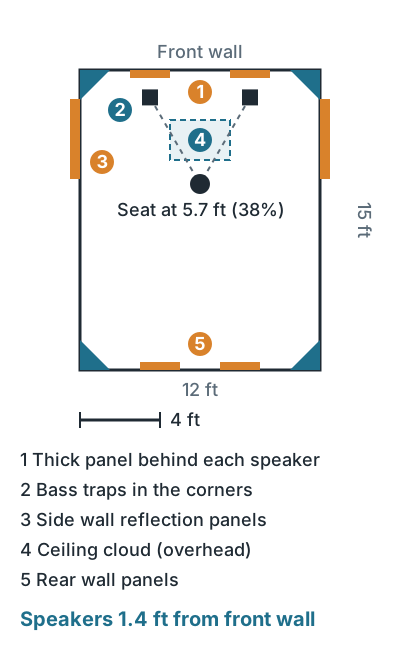
- Face the long way. Point the speakers down the room's long dimension and make an equilateral triangle with your head (RealTraps room setup (opens in a new tab)).
- Seat at 38%. Sit 38% of the room length from the front wall, 5.7 ft in a 15 ft room; the 38% rule explains where the number comes from and where it falls short.
- Treat the front wall. Keep the speakers under 2 ft from it, as Genelec (opens in a new tab) advises, and hang a thick panel behind each one; see panels behind speakers.
- Trap the corners. If you've only got two bass traps, RealTraps puts them in "the front left and right wall-wall corners" (RealTraps (opens in a new tab)).
- Cover the side-wall reflections. Find them with the mirror trick; where to place acoustic panels walks you through it.
- Hang a ceiling cloud. RealTraps treats all the first reflection points, and the ceiling one sits halfway between you and the speakers.
- Finish the rear wall. Primacoustic suggests doing it after the side walls and warns that "too much absorption will remove the energy and excitement" (Primacoustic (opens in a new tab)).
The same reflection points matter for your voice. In a streaming or voice-over room, sound from your mouth bounces off the nearest walls and right back into the mic. So treat the walls closest to where you sit and talk.
How thick should studio panels be?
Use 2 in. panels at the reflection points and 4 in. or thicker for bass. In Owens Corning's data, 2 in. 703 absorbs 15% of the sound at 125 Hz and 4 in. absorbs 56%, even though both score NRC 1.00 or higher.
Side walls and ceiling
2 in.
NRC 1.00 in 703 board, plenty for the mid and high frequencies NRC measures.
Front wall and corners
4 in.+
The speaker-wall dip and room modes sit near or below 125 Hz.
Thin foam squares
Treble only
1 in. foam is NRC 0.50 at Auralex, and NRC skips the bass.
NRC only averages absorption at 250 to 2,000 Hz (Acoustical Society of America (opens in a new tab)). So a high NRC on a thin panel tells you nothing about kick drums or bass guitar. The Auralex figure comes from its Studiofoam Wedge page (opens in a new tab).
Isolation: keeping sound in and noise out
Isolation gets built into the walls, floor, ceiling and door, and no panel hung on the surface can stand in for it. STC itself is only measured from 125 to 4,000 Hz (ASA (opens in a new tab)), so a wall's rating doesn't tell you how it handles the deepest bass from a kick drum or bass amp.
- Seal first: in PABCO's example (opens in a new tab), one unsealed 1/8 in. gap 1 ft long drops a wall from STC 46 to 36.
- Decouple: resilient channel on one side of an insulated 2x4 wall took it from STC 34 to 48 in USG's tests, against 37 for a second drywall layer.
- Insulate the cavity: worth about 3 STC points with drywall screwed straight to the studs, and about 8 in a decoupled wall (NRC Canada, CBD-239 (opens in a new tab)).
- Watch the low end: CBD-239 says double walls should be designed so their mass-air-mass resonance falls below 80 Hz, because the cavity acts like a spring between the layers.
Example: A drummer's room shares an insulated 2x4 wall (STC 34) with a bedroom. Covering it in 2 in. panels adds 0.5 lb/sq ft of fiberglass and barely moves the STC. Resilient channel on the studio side gets it to 48, which is still short of the STC 50 that IBC Section 1206 requires between dwelling units (LADBS bulletin (opens in a new tab)).
Doors, ducts and outlet boxes carry sound around even a good wall. The soundproof panels guide shows each path and how to fix it.
Building a room to play in, not just record? How to soundproof a music room (opens in a new tab) goes deeper on drums, bass, doors, ventilation and building a room within a room.
FAQ
Do I need bass traps in a small home studio?
Yes. RealTraps says bass "tends to collect in the corners," and for a room with only two traps it picks the front wall-wall corners.
Can I record drums in an apartment with panels?
Not without bothering the neighbors. Panels change how the drums sound in your room, not how much gets into the next unit; renter-friendly options covers what you can do without rebuilding walls.
Should I use foam or fiberglass in a studio?
Fiberglass rates higher at the same thickness: 2 in. Owens Corning 703 rates NRC 1.00 against 0.75 for 2 in. Auralex Studiofoam. The full comparison is in acoustic panels vs foam.
Should a studio cover whole walls?
No. Treat the five zones in the plan above. At each reflection point, Primacoustic says "covering most of the surface will provide plenty of control." The general answer is in do you need to cover the entire wall, the count is in how many acoustic panels you need, and there are more answers in the soundproof panels FAQ.