Home Theater Soundproofing Panels: Where They Go and What They Can't Stop
Updated
Soundproof panels for home theater control reflections inside the room: they clean up dialog and tighten the bass at the seats. What they won't do is keep a subwoofer from shaking the bedroom upstairs. That takes sealed gaps, decoupled walls and ceilings, and a solid door. Plan for both, and build the blocking before you hang the panels.
What home theater soundproofing panels actually do
Home theater soundproofing panels soak up the reflections that blur dialog and smear the surround effects. Dolby's installation guidelines recommend "sound-absorbing and sound-diffusing treatment for handling reflections from the walls, floor, and ceiling" (Dolby Atmos Home Theater Installation Guidelines, 2015 (opens in a new tab)).
Panels fix
Inside the room
Echo, harsh side-wall reflections and, if you use thick traps, some of the bass peaks and dips at the seats.
Panels don't fix
Through the walls
Movie bass getting into bedrooms and other rooms. For that you need mass, decoupling and sealing.
The soundproof panels guide breaks down the difference with NRC and STC data.
Where to put soundproof panels in a home theater
Start with the side-wall reflection points of the front speakers, then do the corners and the rear wall. In a 14 by 20 ft room with the seat 12.4 ft from the screen, the left, center and right speakers all bounce off each side wall between 5.1 and 8.0 ft from the front, so a single panel zone from 4.5 to 8.5 ft covers all three.
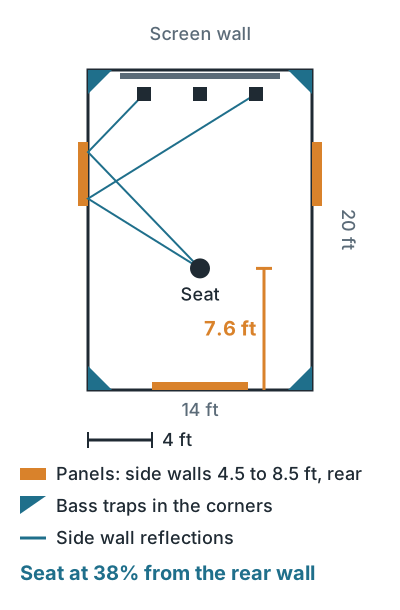
- Side walls: a 2 in. fiberglass panel rates NRC 1.00 (Owens Corning 703 (opens in a new tab)), which is plenty for the dialog range. Check the spots with a mirror, as where to place acoustic panels shows.
- Corners: use bass traps 4 in. or thicker. At 125 Hz, 4 in. 703 absorbs 56% compared with 15% for 2 in.
- Rear wall: panels behind the seats catch the reflection coming back at you from behind.
- Front wall: with an acoustically transparent screen, a thick panel behind each speaker cuts the bass dip caused by the wall bounce. See panels behind speakers.
- Ceiling: treat it for overhead speakers, but leave the patch bare where Atmos-enabled up-firing speakers bounce, because Dolby says that "first audio reflection from the ceiling is desired."
Where to sit: 38% from the back wall
Sit about 38% of the room length from the rear wall, which is 7.6 ft in a 20 ft room. RealTraps gives 38% from the front wall as the spot with the flattest bass and calls the rear-wall version "a good second choice" when the front spot puts you too close to a big screen (RealTraps (opens in a new tab)). The 38% rule covers where it falls short.
Watch out: Don't shove the sofa up against the back wall. CEDIA/CTA-RP22 (opens in a new tab), the industry's recommended practice for immersive audio, "strongly" advises against it. It sets a minimum of 0.5 m (about 1.6 ft) from head to wall at its basic level, 1.5 m (about 4.9 ft) at its top level.
Keeping bass from leaking to the bedrooms
Bass gets out through gaps, ducts and the framing itself, and panels on the walls do almost nothing about it. CEDIA/CTA-RP22 lists the paths: wall, floor, ceiling and door construction, ventilation with shared paths, plumbing and mechanical equipment, and "small flanking paths" such as electrical boxes.
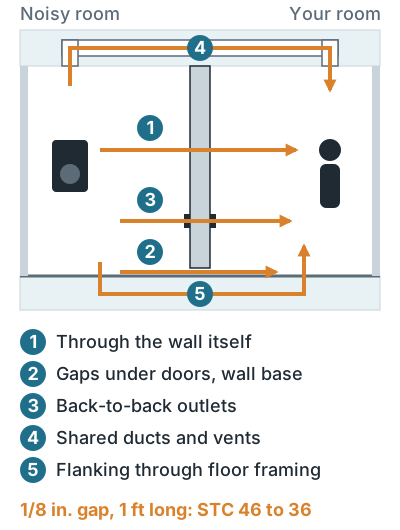
- Seal the gaps. Caulk the wall base, seal the outlet boxes and fit a door sweep and gaskets. In PABCO's example (opens in a new tab) one 1/8 in. gap 1 ft long drops a wall from STC 46 to 36.
- Upgrade the door. CEDIA lists door construction as one of the isolation factors. Soundproof door panels covers sealing a door and adding mass to it.
- Decouple the shared wall or ceiling. Resilient channel took an insulated 2x4 wall from STC 34 to 48 in USG's tests (opens in a new tab). If there's a bedroom above, the theater ceiling needs the same treatment; see soundproof ceiling panels.
- Check the ducts. CEDIA flags ventilation with shared paths to other rooms, because a supply or return duct connects the theater to every room on its run.
STC ratings start at 125 Hz (ASA (opens in a new tab)), so a wall's STC tells you nothing about the deepest bass a subwoofer puts out. NRC Canada's CBD-239 (opens in a new tab) says double walls should be designed so their mass-air-mass resonance stays below 80 Hz, and that means a deep cavity or heavy layers.
FAQ
Do bass traps keep bass from reaching other rooms?
No. Bass traps soak up bass inside the theater to even out the peaks and dips at the seats. Keeping it in the room takes the sealing and decoupling above.
Is STC 50 enough for a home theater wall?
For voices, yes: in Johns Manville's table (opens in a new tab) loud speech isn't audible through STC 50. But movie bass sits partly below the 125 Hz floor of the STC range, so STC 50 on its own doesn't promise quiet bass next door.
Should I use foam panels in a home theater?
Foam does the job at the side-wall reflection points: 2 in. Auralex Studiofoam rates NRC 0.75 (Auralex (opens in a new tab)). In the corners, go with 4 in. fiberglass. It absorbs 56% at 125 Hz, compared with 23% for 3 in. wedge foam (Auralex lab report (opens in a new tab)).
How many panels does a home theater need?
For the 14 by 20 ft room above: one 4 ft panel zone on each side wall, four corner traps and a rear-wall panel behind the seats. You'll find more answers in the soundproof panels FAQ, and room-by-room counts in how many acoustic panels you need.