Soundproof Ceiling Panels: What Fixes Echo and What Stops Upstairs Noise
Updated
Soundproof ceiling panels are absorbers: a 2 in. ceiling cloud rated NRC 1.00 soaks up echo in your room, but it does almost nothing for footsteps or voices from upstairs. You fix noise from above at the floor upstairs, or by hanging the ceiling on isolators, which took one lab floor from IIC 40 to 62.
Echo or noise from upstairs: which do you have?
Echo is sound made in your room bouncing off a hard ceiling. Upstairs noise is footsteps and voices coming down through the floor framing. Panels fix the first one. The second needs a ceiling that doesn't touch the joists.
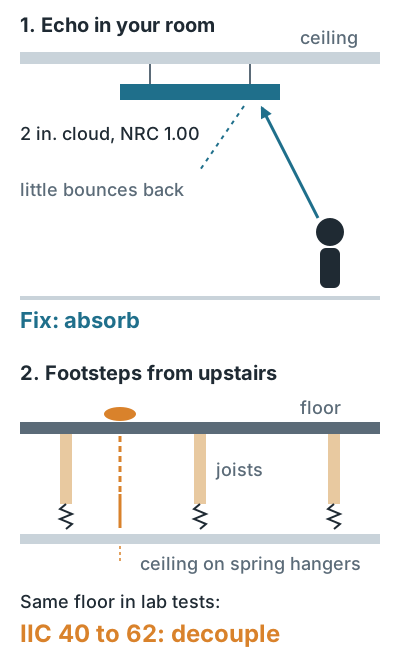
Footsteps are rated by IIC (Impact Insulation Class), the rating for structure-borne noise from a standard tapping machine on the floor above (PABCO Sound Design Guide (opens in a new tab)). Ceiling panel makers publish NRC for absorption, not IIC. For the short answer on each type of noise, see do soundproof panels work on ceilings.
Best soundproof panels for a ceiling with echo
For echo, the best ceiling soundproofing panels are 2 in. fiberglass, hung as clouds or fixed flat, at NRC 1.00. Two-inch foam and Armstrong's Ultima tile rate 0.75.
| Type | Example | NRC | Weight |
|---|---|---|---|
| Suspended cloud | Primacoustic Stratus (opens in a new tab), 2 by 4 ft, 2 in. | 1.00 | 11.5 lb each |
| Rigid fiberglass board, fixed flat | Owens Corning 703 (opens in a new tab), 2 in. | 1.00 | 0.5 lb/sq ft |
| Acoustic foam | Auralex Studiofoam Wedge (opens in a new tab), 2 in. | 0.75 | Not listed |
| Drop ceiling tile | Armstrong Ultima 1912 (opens in a new tab), 3/4 in. | 0.75 | 1.05 lb/sq ft |
Primacoustic's Stratus data sheet (opens in a new tab) calls the suspended cloud "very effective at absorbing sound from 100Hz and up," and the air space behind it helps. With board fixed flat, the thicker stuff reaches lower: 703 absorbs 0.15 at 125 Hz at 2 in. and 0.56 at 4 in.
Example: A 12 by 15 ft room has a 180 sq ft ceiling. Four 2 by 4 ft clouds cover 4 × 8 = 32 sq ft, about 18% of it. Start over the desk or sofa, and only add more if the room still rings.
The mounting hardware and steps are in how to hang acoustic panels on a ceiling. To figure out counts for a whole room, see how many acoustic panels you need, and check the fire rating of anything you put overhead in are acoustic panels fire resistant.
Drop ceiling tiles: echo control, a little blocking
Acoustical drop ceiling tiles carry two ratings: NRC for echo and CAC (Ceiling Attenuation Class) for blocking. Armstrong defines CAC as a ceiling's efficiency as a barrier to airborne sound between rooms "that share a common air plenum" (Armstrong ceiling performance FAQs (opens in a new tab)). In other words, it's about sound traveling sideways over walls, not down from the floor above.
Even a tile at 1.05 lb/sq ft weighs less than half as much as one layer of 5/8 in. drywall at 2.2 lb/sq ft (USG (opens in a new tab)).
Less echo
NRC 0.75, CAC 35
Ultima 1912 at 1.05 lb/sq ft: it absorbs better.
More privacy
NRC 0.60, CAC 40
Ultima 1952 at 1.31 lb/sq ft: it blocks better.
Why ceiling panels don't stop upstairs noise
Footsteps shake the floor, the joists carry that vibration, and the ceiling drywall screwed to them passes it into your room like the skin of a drum. Weyerhaeuser's Trus Joist floor guidance puts a typical single-family floor with hardwood or vinyl at IIC 30, compared with the IIC 50 the code requires between dwelling units (Los Angeles Department of Building and Safety, IBC 1206 (opens in a new tab)).
Weyerhaeuser (opens in a new tab) also notes that a gypsum ceiling "attached to wood or stiff metal furring will not provide significant improvement." An absorber glued under that ceiling is lighter than the drywall it hangs from, so expect even less out of it.
What stops noise from upstairs
Two things stop footsteps: something soft on the floor above, and a ceiling that's separated from the joists. Voices and TV also need the gaps sealed and some added mass.
Rug and pad upstairs
IIC 54 to 73
Carpet with pad compared with engineered hardwood on the same tested floor (Rockwool (opens in a new tab)).
Resilient channel
+10 STC and IIC
Weyerhaeuser's figure for channel alone; you get more with insulation in the joist bays.
Spring hangers
IIC 40 to 62
Kinetics ICW hangers under the same joist floor, lab tested.
Seal and insulate
+5 STC
Insulation alone adds about 5 STC and no IIC. Recessed lights are open holes, and they need sealing.
Rule: Absorb echo at the ceiling. Stop footsteps at the floor above, or with a ceiling that doesn't touch the joists.
The low-cost order of attack is in how to soundproof a ceiling cheaply, the no-demolition and tear-off options are in how to soundproof an existing ceiling, and dealing with the people upstairs is in how to soundproof a ceiling from noisy neighbors. For walls, the soundproof panels guide covers mass, decoupling, damping and sealing.
FAQ
Do ceiling clouds need an air gap?
They work better with one. Primacoustic credits part of its Stratus cloud's absorption to the air space behind the suspended panel, and board mounted flat needs more thickness to reach the same low frequencies.
Will a drop ceiling stop footsteps?
Not on its own. Tile ratings (NRC and CAC) cover echo and sound between rooms that share a plenum, not impact from the floor above, which is rated by IIC.
Do recessed lights let noise through the ceiling?
Yes. PABCO calls recessed lights "large open holes in the ceiling" that are "very difficult to treat," and its fix is a sealed box of QuietRock around each fixture inside the joist bay.
Are thicker ceiling panels better?
For bass, yes: going from 2 to 4 in. of Owens Corning 703 nearly quadruples its absorption at 125 Hz. For footsteps, thickness doesn't matter, because the problem isn't absorption.
Can one ceiling product fix echo and footsteps?
No single panel does both. Build or retrofit the decoupled ceiling first, then hang absorbers below it. You'll find more answers in the soundproof panels FAQ.