Office Soundproofing Panels: Privacy, Echo and Glass Partitions
Updated
Office soundproofing panels fix echo and keep chatter from spreading across an open office. What they won't do is make a meeting room private. The federal GSA's office acoustics guide asks for ceilings rated NRC 0.9 in open plan areas, and for private office walls of STC 40 and confidential rooms of STC 45, built full height and sealed (GSA Sound Matters (opens in a new tab)). Panels take care of the first job. Walls, doors and glass take care of the second.
Absorb, block, cover: the three office tools
GSA's guide breaks office noise control into three tools and recommends using all of them: absorb sound in the room, block it between rooms, and cover whatever's left with background sound.
Absorb
NRC 0.9
Ceiling minimum for open plan areas, across the whole ceiling. Wall and desk panels add to it.
Block
STC 40 to 53
Walls between private offices, confidential rooms and teleconference rooms.
Cover
45 to 48 dBA
Sound masking level for open plan areas; 40 to 42 dBA in private offices.
Soundproof panels for office walls only cover the "absorb" part. The soundproof panels guide explains why absorbing and blocking take different products.
Open office: panels for echo and spread
In an open office the ceiling does most of the absorbing, so start up there. GSA calls for NRC 0.9 minimum on 100% of the open plan ceiling. Then wall panels and desk screens cut down what bounces off hard walls and carries from desk to desk.
- Ceiling: NRC 0.9 or higher tiles or hanging panels over the whole area. If you've got a suspended ceiling with low-NRC tiles, those are the first thing to swap out.
- Walls: fabric-wrapped fiberglass or mineral wool panels on the hard walls closest to the desks. 2 in. of fiberglass board rates NRC 1.00 (Owens Corning 703 (opens in a new tab)).
- Desk screens: GSA recommends 51 in. maximum for seated privacy and 66 in. as the tallest workstation, with glass above 51 in. so light gets through.
How many acoustic panels do I need and where to place acoustic panels cover how many wall panels a space needs and where they go.
Speech privacy in offices and meeting rooms
Speech privacy between rooms comes down to the wall's STC, not the panels inside the room. GSA defines normal privacy as a casual listener catching about 20% of words (Privacy Index 80) and confidential privacy as about 5 words in 100 (Privacy Index 95).
| Room | Privacy | Wall STC | Background noise (NC) max |
|---|---|---|---|
| Private office | Normal | 40 | 35 |
| Conference room, executive office | Confidential | 45 | 30 (25 in meeting rooms) |
| Teleconference or video room | Confidential | 53 | 20 |
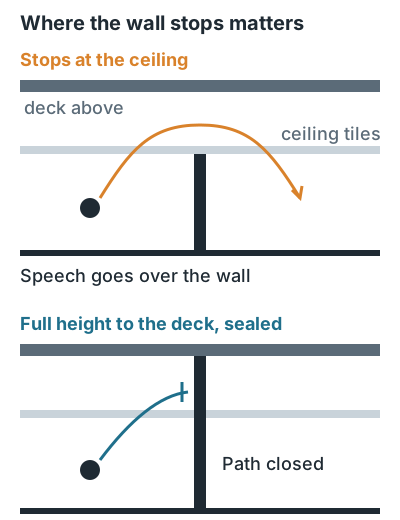
In a lot of private offices, the door is the weak link. GSA rates hollow-core doors "only good to poor" and says solid or insulated core doors can be "very good" with continuous closed-cell foam seals on three sides. Soundproof door panels shows how much the seals alone add.
Soundproof glass panels and partitions
Glass partitions can hit the private office target, and some hit the confidential one, but single glazing can't. Single 1/2 in. glass rates STC 36 (Viracon (opens in a new tab)), while one double-glazed partition system rates STC 39 with two plain 1/4 in. lites and 46 to 47 with laminated glass (C.R. Laurence 487-AR (opens in a new tab)).
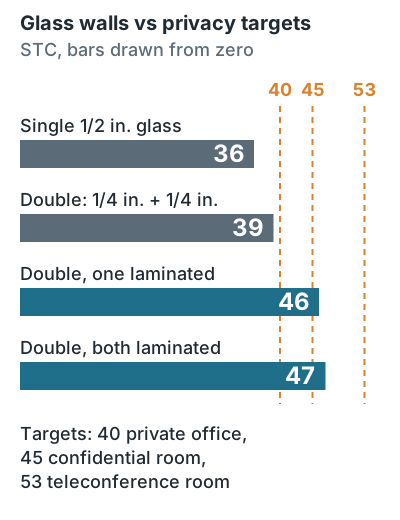
Watch out: The glass rating is only part of the wall. GSA notes that sliding doors are largely glass and "do not have a high STC rating," and that pivot doors leave gaps on all four sides. So a laminated glass wall with a gappy glass door performs like the door.
If a glass conference room already echoes, let ceiling panels and one absorptive wall do the absorbing. GSA's meeting room guidance is NRC 0.8 on 50% of the ceiling plus 25% of two adjacent walls.
Warehouse soundproofing panels
Warehouse soundproofing panels, like hanging baffles or wall panels, cut down the noise that builds up bouncing around a hard space. They don't touch the noise you hear standing right next to the machine. OSHA's technical manual says absorption "does not reduce noise resulting from direct sound propagation" and works best in spaces under about 10,000 sq ft (OSHA Technical Manual, Noise (opens in a new tab)).
| Control | Typical reduction | Best for |
|---|---|---|
| Absorptive panels or baffles | Not given as a dB figure; cuts reverberant build-up | Hard-walled spaces where noise from far machines adds up |
| Partial barrier | 15 to 20 dB practical limit | Workers in the direct path of one machine |
| Enclosure around the machine | 20 to 40 dB | A single loud machine |
If a worker stands next to the noisy machine, panels on the walls won't lower what that worker hears. An enclosure or barrier at the source will.
FAQ
Do desk divider panels stop people overhearing calls?
No. They cut some of the direct sound between seated neighbors, but speech still bounces off the ceiling. So an NRC 0.9 ceiling and some background sound matter as much as how tall the screen is.
Is sound masking a replacement for panels?
No, it's the third tool. GSA recommends using all three, and when the budget forces a choice, it puts absorption first, blocking second and masking third.
Can I add soundproofing panels to an existing office wall for privacy?
Not really. Privacy depends on the wall's STC, and panels add absorption, not blocking. Run the wall up to the deck, seal it and fix the door first.
What STC do I need for a glass conference room?
STC 45 for confidential talks under GSA's targets. In the system above, that means laminated double glazing at 46 or 47. There are more answers in the soundproof panels FAQ.