Acoustic Panels vs Soundproofing: The Difference That Saves You Money
Updated
Acoustic panels soak up sound inside a room so it echoes less. Soundproofing stops sound from getting from one room to another. With acoustic panels vs soundproofing, the ratings tell you everything: panels get an NRC, walls get an STC, and a panel with a perfect NRC of 1.00 adds almost nothing to a wall's STC. So buy the one that matches where your sound starts.
Acoustic panels vs soundproofing, side by side
Acoustic panels handle sound inside a room. Soundproofing handles sound between rooms. The two have almost no materials in common.
| Acoustic panels | Soundproofing | |
|---|---|---|
| Job | Cut echo and reverb in the room | Stop sound getting in or out |
| Rating | NRC, tested to ASTM C423 | STC, tested to ASTM E90 and rated by ASTM E413 |
| Typical materials | Foam, fiberglass, mineral wool, felt | Drywall, mass loaded vinyl, resilient channel, damping compound, sealant |
| Weight | 0.5 lb/sq ft for 2 in. fiberglass board | 2.2 lb/sq ft for one layer of 5/8 in. drywall |
| Installation | Hung on the surface; gaps between panels are fine | Continuous and airtight; one 1/8 in. gap can cost 10 STC points |
| What you notice | Clearer speech, less ringing | Quieter neighbors, less noise leaving |
The weights come from the Owens Corning 703 data sheet (opens in a new tab) (3.0 lb/cu ft × 2 in. ÷ 12 = 0.5 lb/sq ft) and USG's Firecode X spec (opens in a new tab). Blocking needs what's in the heavier column. A panel that's four times lighter than one sheet of drywall can't do drywall's job.
NRC vs STC: two different scales
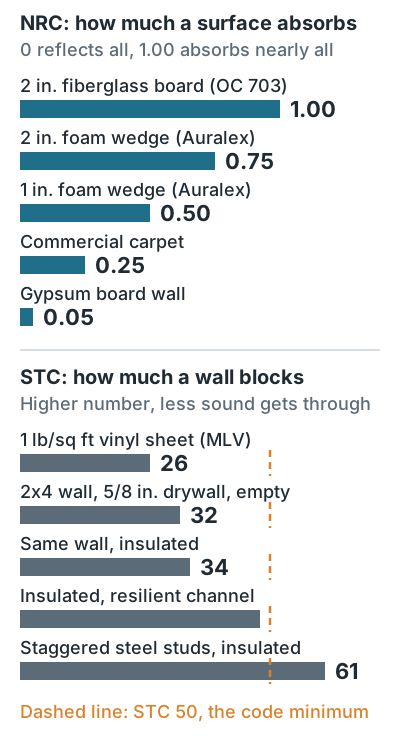
NRC runs from 0 to about 1 and tells you how much of the sound hitting a surface it absorbs. STC for real walls and barriers runs from the 20s to the 60s and tells you how much sound a wall or partition stops.
Rule: NRC is the average absorption at 250, 500, 1,000 and 2,000 Hz, rounded to the nearest 0.05. STC is a reference curve fitted to lab transmission loss in 16 bands from 125 to 4,000 Hz. (Definitions: ASA, NRC (opens in a new tab) and ASA, STC (opens in a new tab).)
Interactive
NRC and STC, bar by bar
Tap a bar to see what the number means and where it comes from.
NRC how much sound a surface absorbs, 0 to about 1
STC how much sound a wall or barrier stops
Code minimum STC 50
STC 50 is the building code minimum between dwelling units, or 45 in field tests (LADBS bulletin on IBC Section 1206 (opens in a new tab)). At 50, loud speech next door is not audible (Johns Manville (opens in a new tab)).
Based on: Acoustic Panels vs Soundproofing, Soundproofing Panels
You can't convert one number into the other. A gypsum wall absorbs almost nothing (NRC 0.05) but blocks reasonably well (STC 32 to 34). Meanwhile the 703 data sheet gives fiberglass board an NRC of 1.00 at 2 in. and no STC at all.
How acoustic panels work
Acoustic panels are porous. Sound gets into the fibers or open cells and turns into tiny amounts of heat, so less of it bounces back into the room (PABCO Sound Design Guide (opens in a new tab)). Whatever makes it through the panel then hits the wall, and the wall passes about as much sound to the next room as it did before.
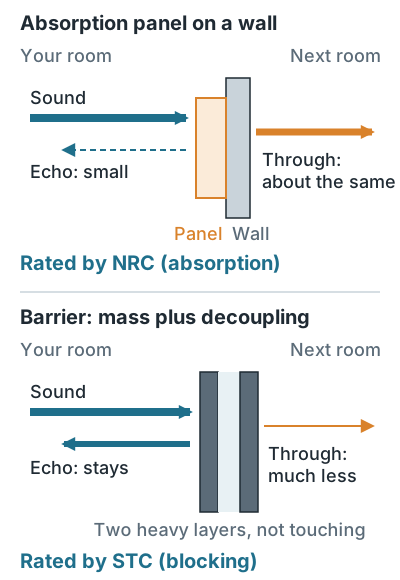
For how they do in real rooms, see do acoustic panels work. For the blocking question, see do acoustic panels soundproof a room and do acoustic panels keep sound out.
How soundproofing works
Soundproofing uses four tools: mass, decoupling, damping and sealing. Not one of them is an acoustic panel.
Mass
STC 26
A 1 lb/sq ft vinyl barrier by itself.
Decoupling
+14 STC
Resilient channel on one side of an insulated 2x4 wall.
Damping
CLD
A viscoelastic layer bonded between two stiff sheets soaks up vibration.
Sealing
46 to 36
What a single unsealed 1/8 in. gap, 1 ft long, costs a wall.
The figures come from the Johns Manville vinyl barrier data sheet (opens in a new tab), USG's lab tests (STC 34 to 48) and PABCO's guide. The soundproof panels guide walks through each method and the products that use it.
Which one do you need?
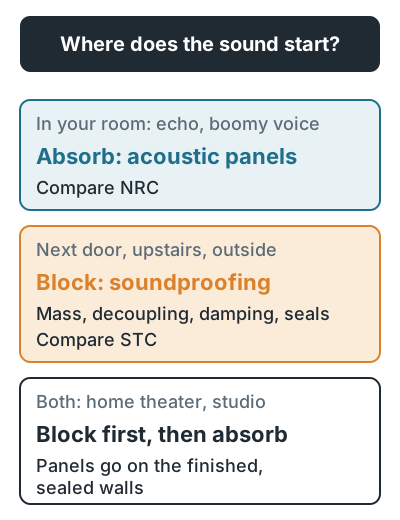
If the sound starts in your room, you need acoustic panels. If it starts anywhere else, you need soundproofing.
- Clap once in the middle of the room. If you hear a fluttery ring that hangs around, you've got bare parallel surfaces, and panels will fix it.
- Sit in silence with your own devices off. Can you still make out voices, a TV or traffic? Then the sound is coming in, and panels won't fix it.
- Check for light around the door edges and outlets from the dark side at night. Anywhere light gets through, air and sound get through too.
- Work in order: seal the gaps, then block, then absorb.
Where the money goes wrong
The classic mistake is buying panels for a noise problem. No pile of surface panels will give a wall the weight or separation it needs.
Example: Cover an 8 by 10 ft shared wall (80 sq ft) with 2 in. fiberglass panels and you add 80 × 0.5 = 40 lb. One extra layer of 5/8 in. drywall over the same wall adds 80 × 2.2 = 176 lb, and in USG's tests that layer was worth 3 STC points. The panels carry less than a quarter of that weight.
Rooms that need both, like home theaters and studios, should get the blocking built first. Then hang the panels on the finished walls. Do soundproof panels work lays out what panels can and can't do.
FAQ
Can a room have good acoustics and good soundproofing?
Yes. Studios and home theaters do both. A sealed, decoupled shell blocks the sound, and absorption panels inside keep the echo in check.
Is soundproofing foam different from acoustic foam?
No. Foam sold for soundproofing is open-cell acoustic foam. Auralex lists NRC values for its Studiofoam wedges (0.75 at 2 in.) and no STC.
Do panels with a higher NRC block more sound?
No. NRC only measures what a surface absorbs. A panel rated 1.00 still leaves the wall's STC pretty much where it was.
Does insulation inside a wall count as soundproofing?
Partly. NRC Canada puts the gain at about 3 STC points when drywall is screwed straight to wood studs and about 8 points in decoupled walls (CBD-239 (opens in a new tab)). So insulation pays off most when you pair it with decoupling.
Is mass loaded vinyl an acoustic panel?
No. MLV is a barrier rated by STC (26 at 1 lb/sq ft), not an absorber rated by NRC. You'll find answers to other questions in the soundproof panels FAQ.