Styrofoam Soundproofing Panels: Why They Don't Work
Updated
Styrofoam soundproofing panels don't work: rigid polystyrene foam is closed-cell, so it reflects sound instead of absorbing it, and at about 0.075 lb/sq ft per inch it's way too light to block noise. A panel can do two jobs, and styrofoam flunks both. Open-cell acoustic foam takes care of echo, and mass plus sealing takes care of noise through walls.
Why styrofoam doesn't absorb sound
To absorb sound, a material has to let it in, and styrofoam's cells are sealed shut. Think of a sponge next to a plastic cutting board. "Closed-cell foams, eg. polystyrene, are poor sound absorbers," says Western Australia's workplace safety regulator (WorkSafe WA (opens in a new tab)). Open-cell acoustic foam lets sound in, and that's why 2 in. of it rates NRC 0.75 (Auralex (opens in a new tab)).
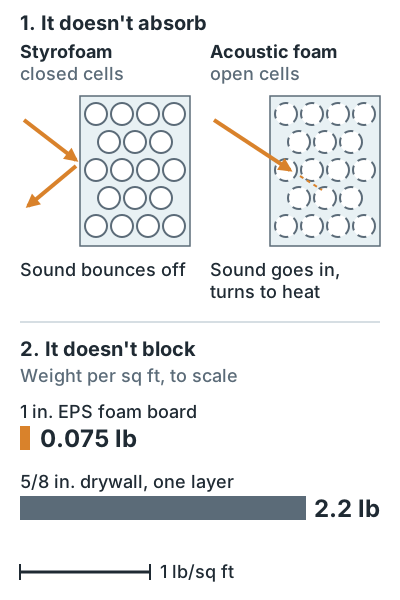
"Styrofoam" is DuPont's trademark for extruded polystyrene (XPS) building insulation, which DuPont describes by its "closed-cell structure and rigid foam board technology" (DuPont (opens in a new tab)). The white beaded board most people call styrofoam is actually expanded polystyrene (EPS), and it's rigid and closed-cell too. Both are sold to stop heat, not sound.
Why styrofoam doesn't block sound
Blocking sound takes weight, and polystyrene board weighs next to nothing. ASTM C578 sets the lightest EPS grade at 0.90 lb/cu ft and common XPS at 1.30 lb/cu ft (Owens Corning bulletin (opens in a new tab)).
Example: 1 in. of 0.90 lb/cu ft EPS weighs 0.90 ÷ 12 = 0.075 lb/sq ft. One layer of 5/8 in. drywall weighs 2.2 lb/sq ft (USG (opens in a new tab)). To match that one sheet, you'd need 2.2 ÷ 0.075 = 29 in. of EPS, and in USG's lab tests (opens in a new tab) that sheet only lifted an insulated wall from STC 34 to 37.
Rule: For a single layer, every doubling of weight per square foot adds only about 6 dB of sound blocking (NRC Canada, CBD-239 (opens in a new tab)). Start at 0.075 lb/sq ft and doubling gets you almost nowhere.
Panels glued to a wall also leave the real leaks wide open: gaps under doors, outlets and shared ducts. The soundproof panels guide covers what actually blocks noise between rooms.
Fire risk: foam board can't be left bare
Building codes don't let foam plastic insulation sit exposed inside a room. IBC Section 2603.4 requires it to be "separated from the interior of a building by an approved thermal barrier," such as 1/2 in. gypsum wallboard (model text as printed in the Seattle Building Code (opens in a new tab)).
So if you cover the board with drywall to meet that rule, the drywall is doing whatever blocking gets done, not the foam. Glue bare polystyrene sheets to a bedroom wall and you've added exactly the exposed foam plastic the code is written to prevent, with no sound control to show for it.
What to use instead
Match the material to the problem: open-cell foam or fiberglass for echo, mass and seals for noise from next door.
Echo in the room
Absorb
Open-cell acoustic foam, NRC 0.50 to 1.10 depending on thickness. Soundproof foam panels
Noise through a wall
Block
Another layer of drywall, decoupling or MLV. Soundproof drywall panels
Gaps and doors
Seal
Sweeps, gaskets and caulking the gaps at the wall base. Cheapest way to soundproof a room
If money's tight, cheap alternatives to acoustic panels lists options that really do absorb sound.
FAQ
Is pink or blue XPS board better than white EPS for sound?
Barely. XPS starts at 1.30 lb/cu ft compared with 0.90 for EPS, so 1 in. weighs about 0.11 lb/sq ft. That's still a twentieth of one sheet of 5/8 in. drywall, and it's every bit as closed-cell.
Does styrofoam help inside a wall cavity?
Not for sound. Cavity fill helps by absorbing, which is worth about 3 STC points in an ordinary stud wall and 8 in a decoupled one (CBD-239 (opens in a new tab)), and closed-cell polystyrene is a poor absorber. Put fiberglass or mineral wool batts in there instead.
Would thicker styrofoam work?
No. Even 4 in. of EPS weighs about 0.3 lb/sq ft, and making it thicker doesn't open up the cells. It still doesn't absorb, and it still doesn't block.
Is styrofoam the same as acoustic foam?
No. Acoustic foam is soft and open-celled, so air and sound can move through it. Styrofoam is rigid and sealed. You'll find more answers in the soundproof panels FAQ.