How Do Soundproof Panels Work?
Updated
Soundproof panels work in one of two ways: absorbers (foam, fiberglass, felt) turn sound bouncing around a room into tiny amounts of heat, which cuts echo, and barriers (vinyl, drywall, damped boards) stop sound from crossing a wall using mass, decoupling and damping. So how do soundproof panels work on noise from next door? Only the barrier kind does anything, and only when it's sealed into the wall.
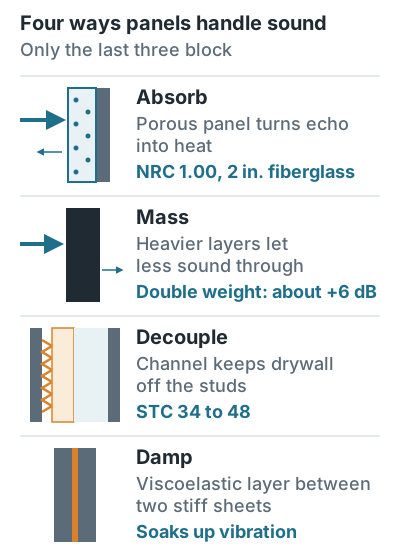
- Absorption: a 2 in. Owens Corning 703 (opens in a new tab) board rates NRC 1.00 but weighs only 0.5 lb/sq ft, so it hardly changes what gets through. There's more on this kind in what acoustic panels do.
- Mass: double the weight of a single layer and you get about 6 dB more (NRC Canada, CBD-239 (opens in a new tab)). Johns Manville's vinyl barrier goes from STC 26 at 1 lb/sq ft to 31 at 2 lb/sq ft (data sheet (opens in a new tab)).
- Decoupling: stop the wall's two faces from touching through the studs, so vibration has no bridge to cross. Resilient channel on one side took an insulated 2x4 wall from STC 34 to 48 in USG lab tests (opens in a new tab), against 37 for an extra drywall layer.
- Damping: a viscoelastic layer sandwiched between two stiff sheets soaks up vibration. PABCO's QuietGlue Pro creates this "constrained layer damped lamination" between two layers of drywall or wood (Sound Design Guide (opens in a new tab)).
A leak beats all of them. In PABCO's example, one unsealed 1/8 in. gap 1 ft long drops a wall from STC 46 to 36. The soundproof panels guide shows which panel types use which mechanism, and there are more answers in the soundproof panels FAQ.