Outdoor Soundproof Panels and Fence Barriers: What Cuts Yard Noise
Updated
Soundproof outdoor panels work as barriers, not absorbers: they have to be solid, heavy, gap-free and tall enough to hide the noise source from where you're standing. A barrier that just breaks that line of sight cuts about 5 dB, and the most a thin wall can do is about 20 dB (FHWA Noise Barrier Design Handbook (opens in a new tab)). An opening like a driveway gap, or a fence that stops short of the line of sight, gives most of that back.
How an outdoor sound barrier cuts noise
An outdoor barrier forces sound to bend over its top edge to get to you. The higher the top sits above the line of sight, the farther the sound has to bend and the quieter it is when it arrives. FHWA's handbook gives about 5 dB once the line of sight is just blocked and about 1.5 dB more for each extra meter (3.3 ft) of height.
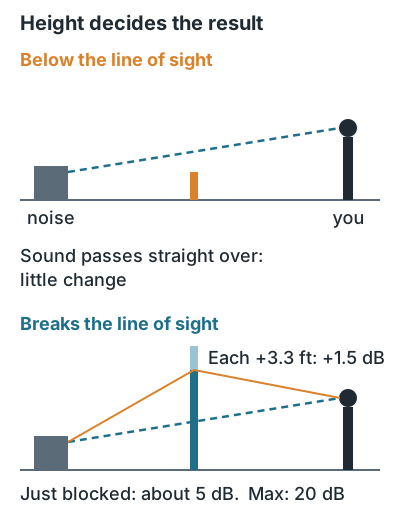
Barriers work better the closer they are to the source, per HUD's Noise Guidebook (opens in a new tab). Someone at an upstairs window sits above most backyard fences. In a draft pickleball study for parks in Tucker, Georgia, a 10 ft barrier protected backyards but second-story windows needed 17 ft (PSM Consulting draft report (opens in a new tab)).
Types of outdoor soundproof panels
Exterior soundproofing panels come in three forms: flexible vinyl blankets you hang on an existing fence, rigid wall panels, and absorptive outdoor panels that cut reflections too.
| Option | Weight or rating | Notes |
|---|---|---|
| Vinyl fence blanket, e.g. Acoustifence (opens in a new tab) by Acoustiblok | 1 lb/sq ft, 1/8 in. thick, STC 28, 6 by 30 ft rolls | Ties onto chain link or wood; check the fence can take the wind load |
| Absorptive outdoor blanket | Barrier core with a soft weatherproof face | Cuts sound bouncing back off the barrier; Kinetics KBC-100RBQ is one example named in a BC pickleball noise guideline (opens in a new tab) |
| Solid board or composite fence | Depends on thickness | Wood shrinks, warps and splits, opening gaps over time (FHWA (opens in a new tab)) |
| Masonry or concrete wall | Rigid and gap-free | The most durable; needs footings, so check local rules on wall height first |
| Hedges and trees | 30 m (100 ft) of dense planting for 5 dB | FHWA calls planting enough to get there not feasible along highways (Keep Down the Noise (opens in a new tab)) |
Acoustic panels made for indoor walls, like foam or fabric-wrapped fiberglass, don't belong on this list. They're light, they absorb instead of block, and most of them aren't built to take rain. The soundproof panels guide explains the difference between absorbing panels and blocking panels.
Rules for a barrier that works
FHWA's highway rules scale down to a backyard: enough weight, enough height, enough length, and no openings.
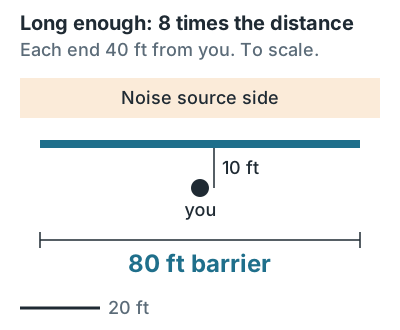
Rule: A barrier of at least 4 lb/sq ft (20 kg/m²) has a transmission loss of at least 20 dB, and each end should be at least 4 times as far from you as the barrier is, so a barrier centered on you runs about 8 times that distance.
- Weight: at 4 lb/sq ft, the sound coming through the barrier is far quieter than the sound coming over it, so past that point the material doesn't matter, per FHWA's handbook (opens in a new tab). For a source smaller than a highway, a 1 lb/sq ft blanket can be enough; a BC pickleball noise guideline (opens in a new tab) asks for at least 5 kg/m², about 1 lb/sq ft.
- Height: break the line of sight from the source to every window and seat you want quieter, then add height if you want more.
- Length: sound wraps around the ends, so if you stand 10 ft from the barrier it needs to be about 80 ft long, centered on you.
- No openings: FHWA says openings for driveways or side streets "destroy their effectiveness" (Keep Down the Noise (opens in a new tab)). Overlap the blanket seams. A narrow gap at the bottom matters less: the handbook puts a continuous base gap of up to 7.8 in. (20 cm) within about 1 dB.
How much do soundproof fence panels cost?
Soundproof fence panel cost comes down mostly to area and to what's holding the panels up. We couldn't find verifiable list prices for outdoor barrier panels, and Acoustiblok sells Acoustifence by quote. Figure out your quantities first so the quotes you get are comparable.
Example: A 100 ft run of 6 ft fence is 600 sq ft. Acoustifence comes in 6 by 30 ft rolls of 180 sq ft, so 600 ÷ 180 = 3.3, or 4 rolls with some left over for overlaps. At 1 lb/sq ft that's 600 lb hanging on the fence, plus the wind load on a solid face. A sound study for Willowbrook, Illinois (opens in a new tab) recommends asking a fence company or engineer about the added wind load before you hang Acoustifence on an existing fence.
Blanket on a fence
Least
Material plus ties. The fence posts might need bracing for wind.
New solid fence
More
Posts, footings and boards or composite panels, built with no gaps.
Masonry wall
Most
Footings and structural design, plus a permit if your town requires one.
What to expect in your yard
A well-built outdoor barrier should cut noise by 5 to 10 dB, which can make traffic sound up to half as loud (FHWA (opens in a new tab)). On a patio you'll notice that, but it won't be silent.
Small fixed sources like an AC unit or a pool pump are the easiest to shield, because the barrier can go right next to them. For sport courts, pickleball soundproofing panels covers court barriers and what studies predict at nearby homes.
FAQ
Do outdoor acoustic panels need to be weatherproof?
Yes. Use panels sold for exterior use, since indoor foam and fabric-wrapped panels aren't made for rain or sun. Are acoustic panels waterproof covers which materials handle moisture.
Will a 6 ft fence block highway noise?
Only where it hides the road from where you're standing, and then by about 5 dB. From an upstairs window or a raised deck you'll probably see right over it, and it won't do much there.
Can I put soundproof panels on a chain link fence?
Yes. Vinyl barrier blankets are made to tie onto chain link. The draft Tucker, Georgia pickleball report says 1 lb/sq ft vinyl is easy to hang on chain link and that the barrier should be at least 6 ft tall, with 8 ft or more working better.
Does a living wall or hedge block noise?
Very little. FHWA puts it at 5 dB for 30 m (about 100 ft) of dense vegetation, which is far deeper than any yard planting. There are more answers in the soundproof panels FAQ.