Fiberglass and Mineral Wool Soundproof Panels: OC 703 vs Rockwool
Updated
Fiberglass soundproof panels are rigid fiberglass or mineral wool boards, 3 to 8 lb/cu ft, wrapped in fabric. At 2 in. thick they absorb NRC 0.95 to 1.05 of mid-range sound, which is more absorption per inch than you'll get from foam. But at 0.5 to 1.3 lb/sq ft they add next to nothing to what a wall blocks. So use them for echo, and use mass and decoupling for noise from next door.
Fiberglass and mineral wool boards compared
At 2 in., the common panel boards all absorb within 0.10 NRC of each other. Where they differ is density, stiffness and how they hold up in a fire.
| Board | Material | Density | NRC 1 in. | NRC 2 in. | Flame spread / smoke |
|---|---|---|---|---|---|
| Owens Corning 703 (opens in a new tab) | Fiberglass | 3.0 lb/cu ft | 0.70 | 1.00 | 5 / 5 unfaced |
| Owens Corning 705 (opens in a new tab) | Fiberglass | 6.0 lb/cu ft | 0.75 | 1.05 | 5 / 5 unfaced |
| Rockwool Comfortboard 80 (opens in a new tab) | Stone wool | 8.0 lb/cu ft | 0.75 | 0.95 | 0 / 0, noncombustible |
| Rockwool Safe'n'Sound (opens in a new tab) | Stone wool batt | 2.5 lb/cu ft | 3 in. only: 1.10 | 6 in.: 1.25 | 0 / 0, noncombustible |
All four beat foam of the same thickness. A 2 in. Auralex Studiofoam Wedge (opens in a new tab) rates NRC 0.75. The full ranking by material is in what material absorbs sound the best, and the other core types are in what acoustic panels are made of.
Thickness matters more than density
Doubling the density from 703 to 705 only nudges 2 in. NRC from 1.00 to 1.05, while doubling the thickness of 703 from 1 in. to 2 in. takes it from 0.70 to 1.00. Low frequencies track thickness even more closely, as these 250 Hz values from the 703 data sheet (opens in a new tab) show.
1 in.
0.26 at 250 Hz
Takes the edge off voices and cymbals, but does little below 500 Hz.
2 in.
0.71 at 250 Hz
The all-rounder for offices, living rooms and call rooms.
4 in.
1.26 at 250 Hz
For corners and bass-heavy rooms. Still 0.56 even at 125 Hz.
Rule: Buy thickness for bass and density for stiffness.
Where density pays off is handling. The 705 board resists 200 lb/sq ft at 10% compression, against 25 lb/sq ft for 703, so its edges stay square in a frame and don't dent as easily.
Rockwool soundproofing panels
Rockwool soundproofing panels hold their shape best when you build them from Comfortboard 80, an 8 lb/cu ft rigid stone wool board. Rockwool's Safe'n'Sound is a 2.5 lb/cu ft batt sized to fit between wood and steel studs.
Where stone wool beats fiberglass is fire. Both Rockwool products are noncombustible to ASTM E136 with a flame spread and smoke index of 0, and Rockwool states the fibers withstand temperatures over 2,000°F (opens in a new tab).
Watch out: The word "soundproofing" on a Safe'n'Sound bag is about its job inside a wall. Hang it on the wall surface and it's just an absorber like any other panel. It won't stop the neighbor's TV.
Soundproofing insulation panels inside a wall
Soundproofing insulation inside a stud wall adds about 2 STC points: in USG lab tests (opens in a new tab) a 2x4 wall rated STC 32 empty and 34 with insulation. The same tests put resilient channel on one side at STC 48, so cavity insulation is a supporting player, not the fix.
What actually blocks is mass, decoupling, damping and sealing; the best material to block sound compares them, and the soundproof panels guide shows where absorbers and barriers each fit in.
How fiberglass panels are built
A fiberglass panel is a rigid board in a light wood frame, wrapped in fabric that breathes. A 24 x 48 in. panel of 2 in. 703 has 8 sq ft of board at 0.5 lb/sq ft (3.0 × 2 ÷ 12), so the core weighs 4 lb; the same panel in Comfortboard 80 weighs 8 × 1.33 = 10.7 lb.
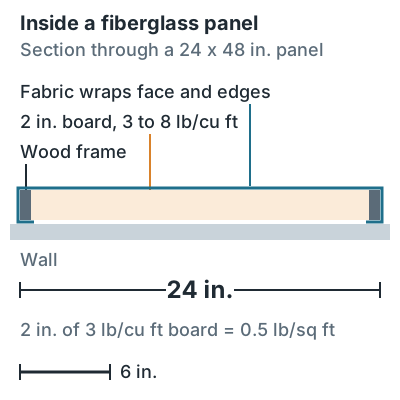
- Unfaced board: facings bounce the highs back. Foil-kraft facing halves 2 in. 703's absorption at 2,000 Hz, from 1.02 to 0.51.
- Breathable fabric: if you can't blow air through it, sound can't get in either. What fabric to use for acoustic panels covers that test and the fire rating to look for.
- Covered back and edges: wrapping it all the way around keeps loose fibers off the wall and out of the room.
Step-by-step building instructions are in how to make acoustic panels.
Are fiberglass panels safe?
Fiberglass and stone wool panels are safe to live with once they're wrapped: the International Agency for Research on Cancer rates insulation glass wool and rock wool Group 3, "not classifiable" (opens in a new tab) as human carcinogens. Loose fibers do irritate your skin, eyes and throat while you're cutting the board, and the ATSDR (opens in a new tab) notes the irritation stops shortly after exposure ends.
Wear gloves, long sleeves, eye protection and an N95 when you cut. The details are in are acoustic panels safe, and fire ratings for every panel type are in are acoustic panels fire resistant.
FAQ
Is OC 703 or Rockwool better for acoustic panels?
For absorption, they're close: 2 in. 703 rates NRC 1.00 and 2 in. Comfortboard 80 rates 0.95. Go with Comfortboard 80 if you want a noncombustible core and stiffer edges, and 703 if you want the lightest panel.
Do I need 705 instead of 703?
Not for sound. 705 adds only 0.05 NRC at 2 in. and weighs twice as much. It's only worth it for freestanding panels or thin edges that get handled a lot.
Can I use insulation batts instead of board?
Batts absorb fine, but they need a frame to hold their shape. Rockwool's Safe'n'Sound batt rates NRC 1.10 at 3 in., so a framed batt panel can match board. It just takes more building.
Should I buy faced or unfaced board?
Unfaced. Kraft or foil facing cuts 2 in. 703 from NRC 1.00 to 0.75 because it bounces the high frequencies back into the room. There are more panel questions answered in the soundproof panels FAQ.
Questions on this topic
- What Are Acoustic Panels Made Of?
- What Is the Best Material to Block Sound?
- What Material Absorbs Sound the Best?
- What Fabric Should You Use for Acoustic Panels?
- Do Acoustic Panels Help With Insulation?
- Are Acoustic Panels Fire Resistant?
- Are Acoustic Panels Safe?
- Are Acoustic Panels Waterproof?
- How Thick Are Acoustic Wall Panels?
- Do Acoustic Panels Absorb Sound?